
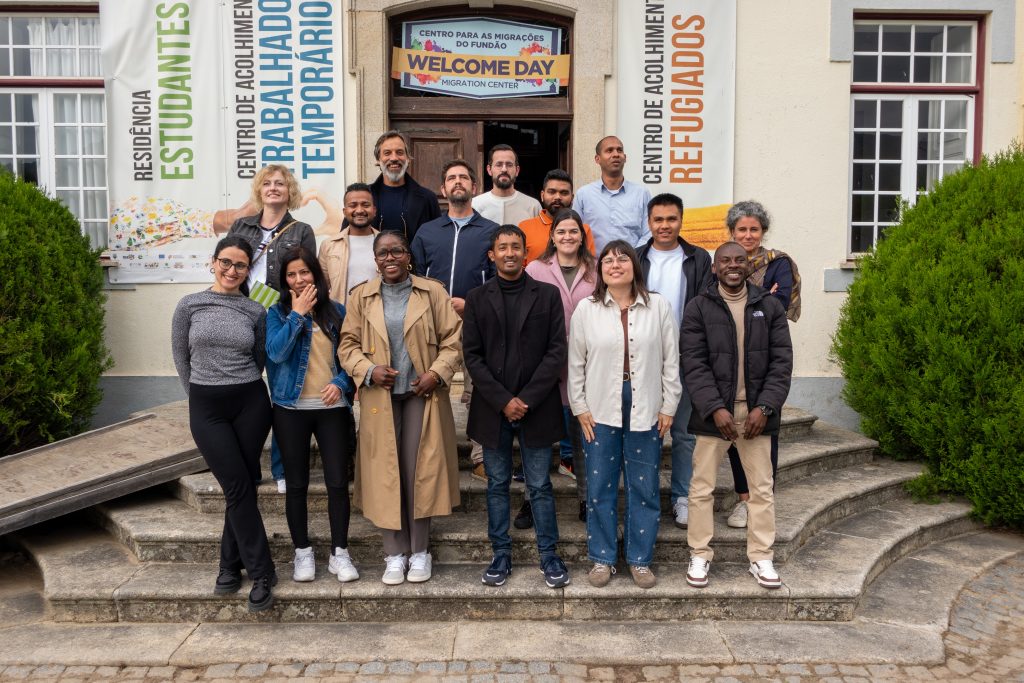
The group of Intercultural Mediators trained by the Integrality project in Portugal
The often unseen contribution of mediation
When a medical consultation, a school meeting or an appointment with a public service proceeds without conflict, the conditions that enabled mutual understanding may remain unnoticed. In some cases, an intercultural mediator has clarified not only the words used but also the circumstances, concerns and expectations on both sides. Their contribution may be overlooked precisely because it prevented a misunderstanding from developing into a problem.
Yahya Abdullah, an intercultural mediator at the Fundão Centre for Migration, describes this lack of visibility in straightforward terms: when an interaction goes well, those involved may not even realise that a mediator contributed to it. This does not diminish the importance of his role. Rather, it indicates that communication was possible.
Although mediators have worked in Portugal for several decades, and sociocultural mediation was recognised under Law No. 105/2001 of 31 August, many people remain unfamiliar with the responsibilities of intercultural mediators. Their role is frequently equated with translation or restricted to conflict resolution. Mediation has a broader purpose: it brings together people, communities and institutions that may not share a language, social conventions or knowledge of how services operate.
Understanding this role requires consideration of both sides of the relationship. Intercultural mediators help people arriving in a new country understand their rights, obligations and procedures. At the same time, they enable schools, hospitals, local authorities, businesses and public services to recognise obstacles that may be invisible to those already familiar with the system. To understand the significance of their work, it is useful to begin with the distinction between mediation and the transmission of words alone.
Beyond linguistic translation
Translation and mediation can complement one another, but they are distinct activities. Translation conveys a message from one language into another. Mediation also takes account of the context in which the message is expressed, how it is received and the conditions required for both parties to understand one another.
Yahya explains that a sentence can be translated accurately and nevertheless cause misunderstandings as a result of cultural differences, previous experiences or an individual’s relationship with an institution. The mediator therefore seeks to make communication comprehensible in linguistic, cultural and human terms. This requires careful listening and knowledge of the local area and its institutions.
Research on the Portuguese experience describes intercultural mediation as an intervention that brings parties closer together, supports communication, prevents conflict and promotes institutional adaptation. Its purpose extends beyond addressing an existing problem: it can establish connections, improve strained relationships and anticipate difficulties. This preventive dimension helps explain why its effects are not always visible.
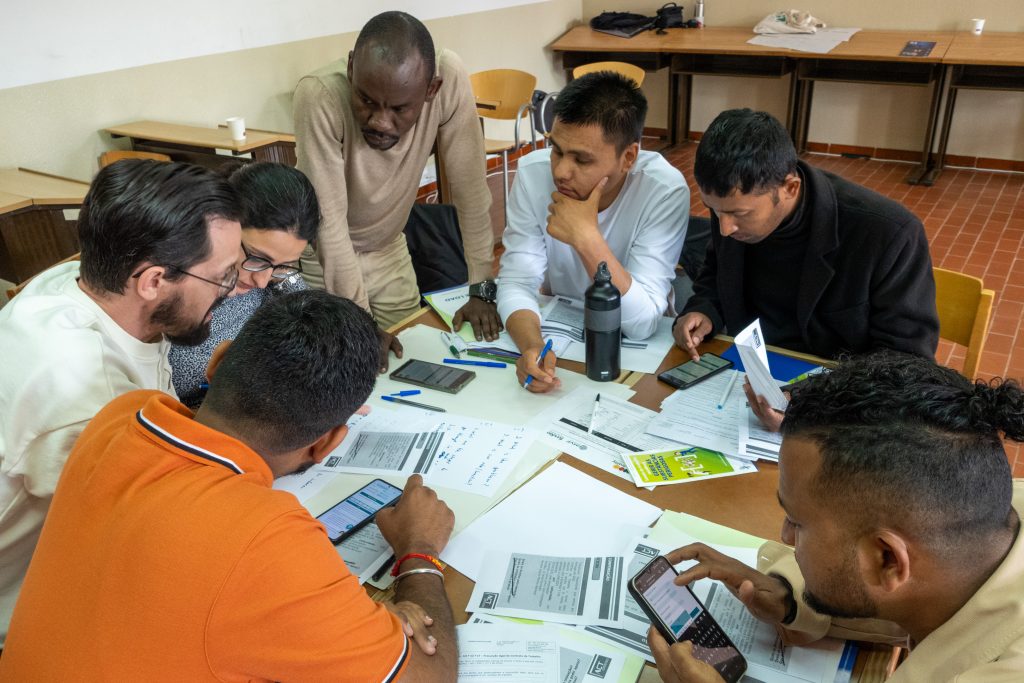
Yahya and the group of intercultural mediators in a labour rights training session facilitated by ACT
From early practice to contemporary mediation
In Portugal, mediation became established in schools and communities during the 1990s, before its legal recognition in 2001. Olga Mariano’s experience at a school in Lisbon’s Padre Cruz neighbourhood helps explain these origins. Her work brought the school closer to families and the Roma community, while creating opportunities for children to share traditions and knowledge and helping to challenge stereotypes.
This example is significant because it illustrates one of the first areas in which mediation developed in practice, not because it gave rise to the legislation. The intervention did more than address individual difficulties: it helped the school gain a better understanding of its pupils and their families. This reciprocal relationship, subsequently extended to other public services, provides a link between the historical example and settings where a failure of communication may have immediate consequences, including healthcare.
When a formal right does not ensure effective access
The importance of this role is particularly evident in healthcare. The study “Ser Enfermeiro Obstetra e Mediador Intercultural na interação com mulheres grávidas migrantes”, conducted with ten midwives at a maternity unit in the Greater Lisbon area, shows that, in the absence of intercultural mediators, these professionals informally assume some of their responsibilities, despite having no specific training in mediation.
During pregnancy and childbirth, communication is integral to healthcare. It enables a woman to understand clinical information, express concerns, ask questions and participate in decisions concerning her health and that of her baby. Translation may convey the words used, but it does not always clarify the meaning of an instruction, the available options or the consequences of a decision.
In such circumstances, a trained mediator can enable the woman to participate in decisions about her health and help the healthcare professional obtain clearer information. This reduces the likelihood of misunderstanding without diverting the professional from their clinical responsibilities. Communication thus becomes a shared responsibility.
Two people may formally have the same right of access to healthcare while being unable to exercise it under equivalent conditions. One may understand the information, ask questions and take part in decisions, while the other faces a language or cultural barrier. Formal equality before the law does not automatically produce an equivalent experience. Integrating appropriately trained intercultural mediators into healthcare teams can help services provide more equitable access. This institutional responsibility, however, is not limited to hospitals.
In schools, public offices and municipal services, individuals should not be expected to determine independently how an institution operates and how best to make themselves understood. Institutions must also communicate accessibly with the people they serve. The experience of those undertaking mediation in practice illustrates how this responsibility can be fulfilled.
A reciprocal process of understanding
Yahya’s experience demonstrates how personal circumstances can inform mediation practice. Before arriving in Portugal as a refugee, he spent 25 years in Sudan, a country affected by war, successive crises and political instability. His experience of arriving somewhere without mastering the language, understanding how institutions worked or knowing where to seek help continues to influence the way he supports others.
“I know what it is like to be somewhere where you do not know the system, the language or where to seek help. That is why I try to be patient and listen carefully, because I understand that the person in front of me may be going through a very difficult time,” he explains. His experience helps him understand the difficulties faced by those he supports, while remaining aware of the limits of his role: to help them make their own voices heard, rather than to speak or make decisions on their behalf.
When someone approaches an institution without knowing the language or its procedures, Yahya explains the matter to both the person and the professionals assisting them. He helps the individual understand their rights, responsibilities and next steps. The objective is to enable them to understand and continue the process independently, without becoming dependent on the mediator.
The institution also learns through this interaction. A person’s behaviour or way of communicating may reflect their cultural background or previous experiences. It does not necessarily indicate disrespect or unwillingness to cooperate. By explaining these circumstances, a mediator can prevent hasty interpretations and enable professionals to consider the person beyond the immediate issue that brought them to the service.
Mediation can also support a dimension of integration that extends beyond forms and procedures: participation in community life. For Yahya, feeling integrated involved no longer feeling permanently like a foreigner, forming relationships and having the opportunity to contribute to society. Integration is not confined to knowing where to submit a document; it also entails belonging, recognition and participation.
This presence within a local area can also help challenge stereotypes in practical ways. By explaining circumstances, bringing people into contact and creating opportunities for interaction, mediators can prevent an individual’s behaviour from being treated as characteristic of an entire community. At the same time, they help migrants understand the conventions of the places in which they live.
This dimension brings intercultural mediation close to community outreach, a term used in other countries for roles centred on direct and informal engagement with communities. The roles are not entirely equivalent. Nevertheless, the comparison raises the question of whether mediators should have the resources to maintain a presence locally, understand community networks and establish connections before an urgent situation arises. This question is especially pertinent outside major urban centres.
The role of mediation in agricultural employment
In rural areas, close ties with local communities can be particularly important. Limited transport, services and opportunities to learn Portuguese affect various groups, but create difficulties for people who are also unfamiliar with administrative and employment procedures or who depend on others for information.
Lek Gurung’s account illustrates these circumstances. After working in a restaurant in Lisbon, he settled in a quieter, more rural area with less access to transport, healthcare and supermarkets. For Lek, learning Portuguese is necessary for employment, building relationships and understanding rules and services. Access to learning, however, depends on the availability of courses, places and transport to reach them. Individual autonomy therefore requires accessible services locally; INTEGRALITY responds to this combination of needs.
In this context, the INTEGRALITY project addresses the integration of migrants and the legality of their employment in agriculture. Its approach extends beyond workers to involve local authorities, civil society organisations, businesses, support organisations and migrant communities. The project is based on the principle that integration into employment depends on cooperation among workers, employers and the bodies responsible for safeguarding access to rights and services.
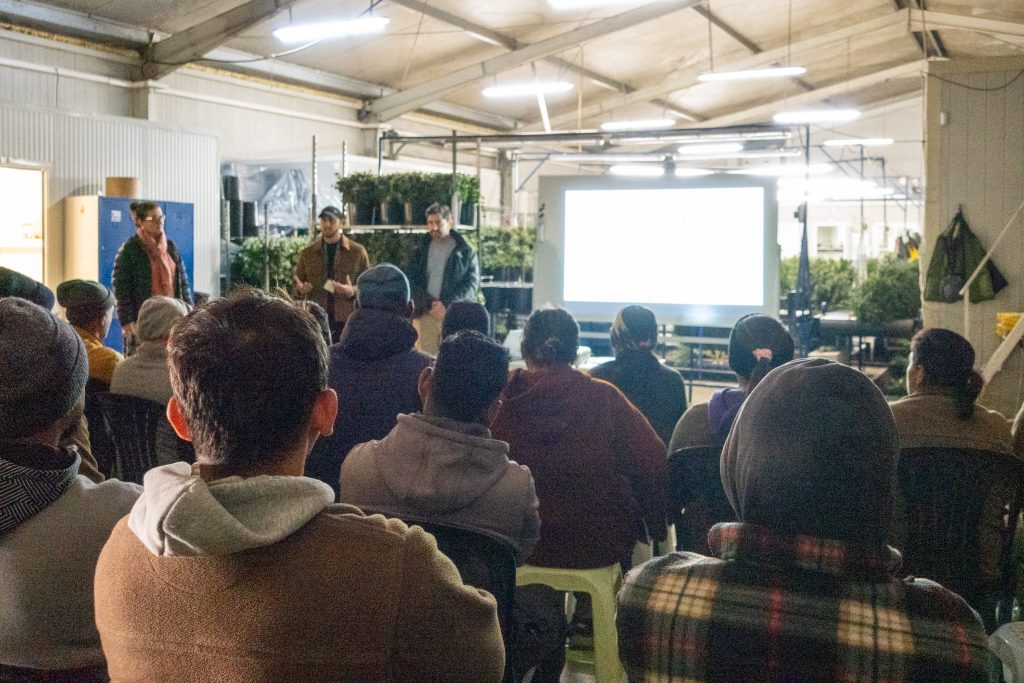
Information session with migrant agricultural workers from Sousa Prado & Filhos, organised in collaboration with TAIPA
In Portugal, the findings from the project’s consultations were brought together in a Local Integration Strategy, a document that identifies needs in the area and guides cooperation among the different parties involved. The strategy found that direct contact, personal invitations in participants’ languages of origin and the presence of mediators already known to them were more effective than communication conducted exclusively through institutional channels.
During awareness-raising activities, participants asked questions about contracts, pay, working hours, documentation, taxes and access to services. Some continued to contact the mediators after the sessions.
Beyond the number of activities delivered, this ongoing contact is instructive: a single session can convey information, but the opportunity to clarify subsequent questions allows participants to relate that information to specific circumstances.
Such support does not replace the intervention of the competent authorities. A mediator may help a worker recognise a possible irregularity and refer them to the Authority for Working Conditions or facilitate communication about housing and transport difficulties. Their role is neither to inspect employment conditions nor to expand the provision of services or compensate for limitations in public services. Rather, it is to reduce the distance between individuals and the responsible bodies, making existing mechanisms more accessible.
In Odemira, the example of Sousa Prado & Filhos Agropecuária shows how intercultural mediation can also support employers. Approximately 60% of its workers are migrants. The company therefore assists them with various everyday procedures and, when more specialised support is required, works with TAIPA and its intercultural mediators. This partnership makes it possible to hold information sessions during working hours, giving workers access to useful information without disrupting their employment.
The support covers employment matters, healthcare, Social Security, the Tax and Customs Authority, AIMA, school documentation and tenancy agreements. The collaboration improves workers’ access to information while also helping the company communicate more effectively, prevent difficulties and understand needs beyond the employment relationship. It further demonstrates the value of cooperation between businesses and local organizations, if it does not replace the responsibilities of public services.
These examples do not represent all migrants, agricultural businesses or regions of Portugal: challenges and resources vary between areas. They do, however, demonstrate the value of mediation as part of a coordinated response. Workers gain a clearer understanding of their rights, businesses can prevent difficulties, and services receive more direct information about the barriers people encounter.

INTEGRALITY activity concerning the integration of migrants in the agricultural sector in Fundão
Professional recognition and continuity
If mediators are important to individuals and institutions, their working conditions must also be considered. Legal recognition of sociocultural mediation was an important step, but it does not ensure the regular presence of mediators within services or the continuity of their work.
The results of INTEGRALITY indicate that trust established within communities can encourage participation, but that proximity alone is insufficient. Limited time, inadequate institutional support and the absence of a stable professional framework constrain mediators’ capacity to organise activities, maintain contact and turn informal relationships into sustained responses.
The same issue arises in healthcare: when no mediator is available, other professionals attempt to respond as best they can. Their efforts may be valuable, but they cannot replace specific training or an organised service. Informally assigning mediation tasks to teachers, nurses, technical staff or public employees increases their workload without ensuring the quality of mediation.
Recognising the value of this work therefore requires more than acknowledging that mediators are needed. It calls for continuing training, stable working conditions, integration within teams, a clear relationship with the competent services and a willingness on the part of institutions to consider what mediators identify through their daily contact with communities.

Vanessa Nhaga, an intercultural mediator in the Centre for Migrations of Fundão, recording an awareness-raising video against labour exploitation in Guinea-Bissau Creole
More than two decades after the legal recognition of sociocultural mediation in Portugal, the challenge is to ensure that the role can be performed consistently and that its contribution is recognised. When supported by institutions, mediators help migrants understand their rights, develop autonomy and participate in community life. They also help schools, healthcare services, local authorities and businesses improve communication, prevent misunderstandings and adapt their responses.
The value of intercultural mediation lies in its capacity to make the relationship between institutions and individuals more understandable and more responsive to human circumstances. It is a bridge in both directions: it supports people seeking to exercise rights and access services, while helping institutions reach those to whom they are accountable.